Vexleynira
Align Collection
Align Collection
Couldn't load pickup availability
Share
- 📄 Digital file available after purchase
- ♾️ Long-term availability
- 🔐 Secure checkout
- 🗓️ Content updated in 2026
Self-paced learning overview
1. Problem Statement
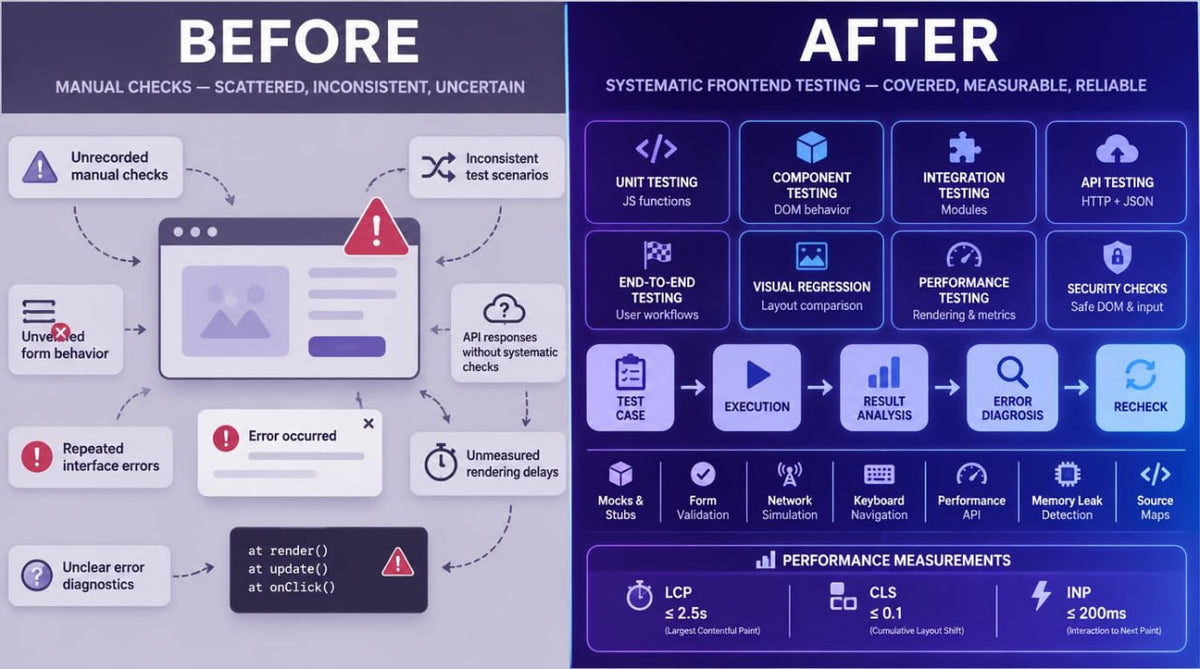
In large web applications, even minor changes to HTML structure, CSS rules, or JavaScript logic can affect the behavior of other components. Manual verification of every scenario takes considerable time and does not always cover every possible combination of states, data, and user actions. Another challenge involves identifying errors that occur only under specific conditions, such as asynchronous operations, screen dimension changes, repeated page loading, or interaction between multiple components. Without systematic testing and performance analysis, technical issues may accumulate and complicate future web application maintenance.
2. Solution
Align Collection presents a systematic approach to web application verification at different levels, from individual functions to complete user workflows. You will learn to design test cases, create isolated checks, simulate external dependencies, and analyze test execution results. A substantial part of the program focuses on DOM, forms, asynchronous workflows, API communication, responsive styling, and inter-component communication. The final project combines testing, diagnostics, performance verification, and error analysis into a comprehensive web interface quality evaluation system.
3. What's Inside
Module 1: Software Quality Engineering Foundations
Explore web application quality characteristics, testing levels, test coverage principles, and the role of systematic testing in development.
Module 2: Test Strategy and Test Architecture
Learn to develop testing strategies, define verification boundaries, distribute scenarios across testing levels, and organize test suites.
Module 3: Testable JavaScript Architecture
Study logic separation, dependency injection, functional module isolation, and code organization principles that support subsequent testing.
Module 4: Unit Testing and Function Isolation
Learn to verify individual functions, boundary values, conditional statements, data transformations, and calculation results.
Module 5: Test Doubles, Mocks, Stubs and Spies
Explore methods for simulating external dependencies, replacing functions with test objects, and checking function calls and passed parameters.
Module 6: Test Fixtures and Data Factories
Learn to create controlled test datasets, object factories, reusable scenarios, and isolated testing environments.
Module 7: DOM Testing and Element Behavior
Study verification of HTML structure, element content, attributes, classes, and DOM changes following JavaScript operations.
Module 8: Component Interaction Testing
Learn to examine component interaction, event handling, parameter transmission, and consistent behavior between related interface elements.
Module 9: Form Validation and Input Testing
Explore validation of required fields, invalid values, boundary conditions, error messages, and form behavior during data entry.
Module 10: Asynchronous JavaScript Testing
Learn to test Promise, async/await, parallel operations, event timing, and asynchronous error handling.
Module 11: API Contract and Response Testing
Study verification of HTTP response structures, request statuses, JSON data, required fields, and conformity of received information to expected models.
Module 12: Network Simulation and Failure Scenarios
Learn to simulate external responses, delays, interrupted requests, connection errors, and repeated operation attempts.
Module 13: Integration Testing and Module Coordination
Explore testing interactions between individual modules, data communication, shared state, and system behavior during sequences of multiple operations.
Module 14: End-to-End Testing and User Journeys
Learn to create end-to-end scenarios that reproduce a sequence of user actions, from initially opening a page to completing a particular operation.
Module 15: Visual Regression and Layout Verification
Study methods for comparing webpage presentation, identifying unwanted styling changes, checking component geometry, and analyzing differences between images.
Module 16: Responsive and Cross-Browser Testing
Learn to examine responsive layouts, breakpoints, component positioning, typography, and interface behavior across different browser environments.
Module 17: Keyboard Interaction and Focus Testing
Explore keyboard navigation, focus order, visible element states, semantic structure, and verification of interactive components without pointer input.
Module 18: Performance Measurement and Browser APIs
Study the Performance API, Resource Timing, PerformanceObserver, and methods for measuring loading time, JavaScript execution, and individual operation duration.
Module 19: Rendering Performance and Layout Stability
Learn to analyze repeated style calculations, layout recalculation, element shifts, excessive DOM updates, and causes of rendering delays.
Module 20: Memory Management and Leak Detection
Explore object lifecycles, event handler management, resource cleanup, closures, and memory leak identification in web applications.
Module 21: Error Diagnostics and Source Maps
Learn to analyze error messages, call stacks, asynchronous exceptions, source maps, and the sequence in which technical issues occur.
Module 22: Client-Side Security Testing
Explore risks involving incorrect HTML processing, cross-site scripting, unsafe input handling, and principles of safe DOM interaction.
Module 23: Applied Studio — Align Quality Laboratory
Create a comprehensive learning project featuring unit, integration, and end-to-end tests, form verification, API scenarios, responsive layout analysis, and web interface performance measurement.
4. Who Is This For?
A suitable choice if you:
✅ Have experience with HTML, CSS, and JavaScript and have created complex web interfaces.
✅ Want to organize your knowledge of web application testing.
✅ Are interested in unit, integration, and end-to-end testing.
✅ Want to identify errors in DOM structures, JavaScript logic, and CSS components.
✅ Want to explore automated checks and test scenario simulation.
✅ Work with APIs, asynchronous operations, and multi-component interfaces.
✅ Want to study performance analysis, memory management, and browser behavior.
This course may not suit you if you:
❌ Are not yet familiar with basic JavaScript syntax and DOM structure.
❌ Have no experience working with HTML and CSS.
❌ Are looking for introductory materials covering the fundamentals of web development.
❌ Expect in-depth server-side testing, server administration, or mobile application testing.
5. What You'll Learn
After studying Align Collection, you will be able to:
-
Develop web application testing strategies.
-
Define testing levels and establish test coverage.
-
Create unit tests for JavaScript functions.
-
Examine boundary values and unusual scenarios.
-
Use mocks, stubs, spies, and test fixtures.
-
Verify HTML structures and DOM changes.
-
Test interactions between independent components.
-
Test HTML forms and validation rules.
-
Test Promise, async/await, and asynchronous workflows.
-
Analyze HTTP responses and JSON data structures.
-
Simulate network communication errors.
-
Conduct integration and end-to-end testing.
-
Create scenarios covering complete user interaction workflows.
-
Analyze visual differences between interface versions.
-
Examine responsive layouts across different browser environments.
-
Test keyboard navigation and focus states.
-
Measure performance through browser APIs.
-
Analyze rendering delays and element shifts.
-
Identify memory leaks and event handler issues.
-
Analyze call stacks, exceptions, and source maps.
-
Verify safe handling of user data.
-
Create comprehensive web interface testing systems.
6. Refund Information
Before placing an order, please review the official Vexleynira Refund Policy. The document outlines refund terms, request submission procedures, and the rules for reviewing related inquiries.
How are the learning materials organized?
How are the learning materials organized?
Each course is divided into themed modules containing technical explanations, code examples, and practical exercises. This structure helps learners examine individual concepts and understand how they relate to one another.
Do I need previous knowledge to study the courses?
Do I need previous knowledge to study the courses?
Not necessarily. The collection includes learning materials for beginners as well as courses covering extended HTML, CSS, and JavaScript topics. The recommended study level is stated in each course description.