Vexleynira
Arc Session
Arc Session
Couldn't load pickup availability
Share
- 📄 Digital file available after purchase
- ♾️ Long-term availability
- 🔐 Secure checkout
- 🗓️ Content updated in 2026
Self-paced learning overview
1. Problem Statement
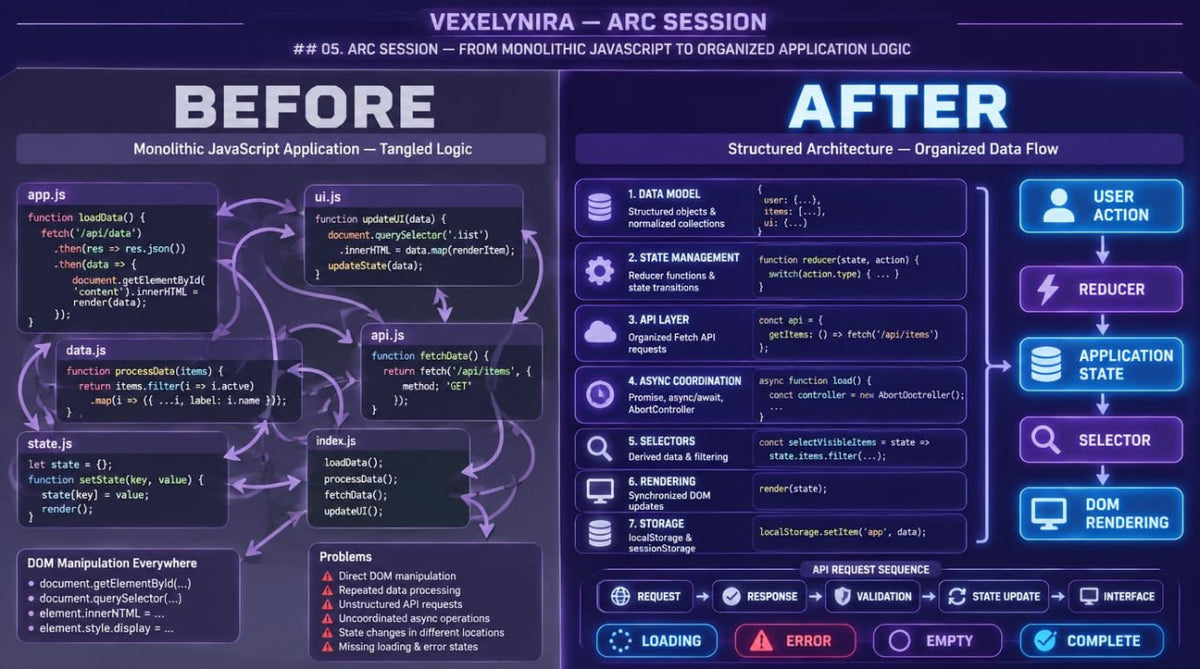
When developing interactive web applications, JavaScript code gradually handles an increasing number of processes, including data processing, state management, communication with remote sources, and interface updates. When all application logic is concentrated in one place, changes to individual functions may affect other parts of the application. Asynchronous requests introduce additional challenges involving operation ordering, error handling, and the presentation of different loading states. Without a clear architecture for data management, routing, and preference persistence, maintaining complex interactive workflows becomes increasingly difficult.
2. Solution
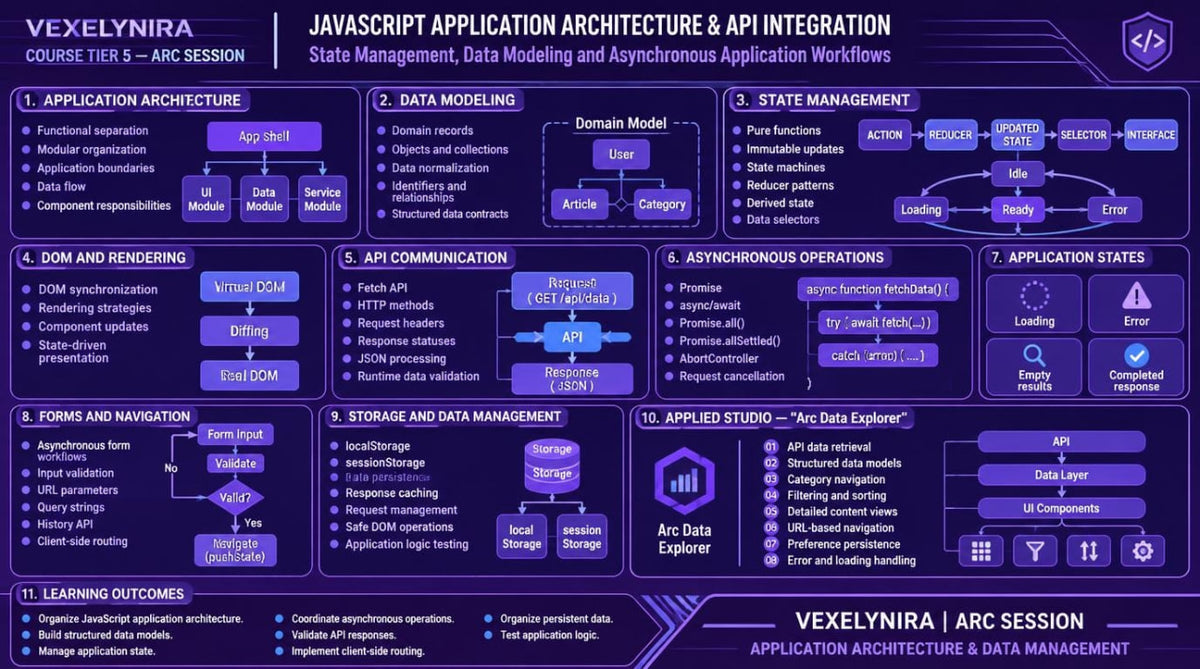
Arc Session presents a structured study of JavaScript application architecture through the separation of logic into individual functional modules. You will explore data models, immutable state updates, functional programming approaches, and transition rules for interface states. A dedicated learning track covers the Fetch API, asynchronous operations, received data validation, request management, and error handling. In the final project, you will create an interactive application featuring dynamic content, filtering, routing, preference persistence, and coordinated data processing.
3. What's Inside
Module 1: JavaScript Application Architecture
Explore the principles of client-side application construction, functional separation, and interaction between individual parts of application logic.
Module 2: Domain Data Modeling and Normalization
Learn to represent domain data through objects and collections, define record structures, and normalize related information sets.
Module 3: Pure Functions and Immutable Data Updates
Study pure functions, data immutability, object and array copying, and methods for creating new states without directly modifying original values.
Module 4: State Machines and Transition Rules
Explore finite state machines, valid transition definitions, and organization of component logic according to the current state.
Module 5: Reducer Patterns and State Coordination
Learn to use reducer functions for event processing, centralized state updates, and coordination of actions between components.
Module 6: Derived State and Data Selectors
Explore derived data, selector functions, combined filters, and calculations based on the current application state.
Module 7: Rendering Strategies and DOM Synchronization
Learn to organize DOM updates according to data changes, separate rendering logic from state processing, and avoid unnecessary document manipulations.
Module 8: Fetch API and HTTP Request Lifecycle
Study HTTP methods, request headers, response statuses, Fetch API operations, and the sequence involved in retrieving data from external sources.
Module 9: JSON Processing and Data Validation
Learn to parse JSON structures, validate value types, handle missing fields, and create consistent internal data models.
Module 10: Async Coordination and AbortController
Explore parallel operations, Promise.all(), Promise.allSettled(), request cancellation management, and the use of AbortController.
Module 11: Loading, Error and Empty States
Learn to organize loading states, error presentation, empty results, and repeated operations within relevant application workflows.
Module 12: Asynchronous Form Workflows
Study multi-step form processing, input validation, asynchronous data submission, and the presentation of operation results.
Module 13: URL State and History API
Learn to work with URL parameters, query strings, and the History API while synchronizing interface state with the current page address.
Module 14: Client-Side Routing Architecture
Explore client-side routing principles, matching addresses with corresponding views, and organizing navigation between application sections.
Module 15: Persistent Client State and Storage
Study localStorage and sessionStorage, learn to preserve preferences, restore state after reopening a page, and organize local data lifecycles.
Module 16: Data Caching and Request Management
Explore response caching, reuse of retrieved data, freshness management, and methods for avoiding duplicated requests.
Module 17: Application Security and Safe DOM Operations
Learn to handle user input safely, use textContent, validate data, and consider the risks associated with incorrect HTML content insertion.
Module 18: Testing Application Logic
Explore pure function validation, state transition testing, test data preparation, and analysis of individual functional modules.
Module 19: Applied Studio — Arc Data Explorer
Create an interactive web application featuring API data retrieval, categories, filters, sorting, detail pages, URL navigation, and user preference persistence.
4. Who Is This For?
A suitable choice if you:
✅ Already have intermediate experience with HTML, CSS, and JavaScript.
✅ Want to move from individual interactive elements to building complete client-side applications.
✅ Are interested in JavaScript architecture and application logic organization.
✅ Want to explore state management, reducer functions, and data models.
✅ Want to study the Fetch API and asynchronous operations.
✅ Want to create applications featuring filtering, routing, and dynamic content.
✅ Are interested in JavaScript function testing and safe data processing.
This course may not suit you if you:
❌ Are not yet familiar with JavaScript functions, arrays, objects, and the DOM.
❌ Are looking for an introductory HTML and CSS course.
❌ Expect detailed coverage of server-side programming languages and server infrastructure.
❌ Do not plan to work with asynchronous logic and more complex data structures.
5. What You'll Learn
After studying Arc Session, you will be able to:
-
Design client-side JavaScript application architecture.
-
Separate application logic into independent functional modules.
-
Create structured data models.
-
Apply data normalization to related collections.
-
Work with pure functions and immutable data structures.
-
Organize state management through reducer patterns.
-
Create state models and define valid transitions.
-
Calculate derived data through selector functions.
-
Organize DOM synchronization with application state.
-
Perform HTTP requests using the Fetch API.
-
Process JSON responses and validate received data structures.
-
Use Promise.all() and Promise.allSettled().
-
Manage asynchronous operation cancellation through AbortController.
-
Organize loading, error, and empty result states.
-
Create asynchronous form processing workflows.
-
Work with URL parameters and the History API.
-
Implement client-side routing.
-
Preserve preferences through localStorage and sessionStorage.
-
Organize caching and reuse retrieved data.
-
Apply safe DOM manipulation methods.
-
Test function logic and state transitions.
-
Combine these concepts in one multi-component JavaScript application.
6. Refund Information
Before placing an order, please review the official Vexleynira Refund Policy. The document outlines refund terms, request submission procedures, and the rules for reviewing related inquiries.
How are the learning materials organized?
How are the learning materials organized?
Each course is divided into themed modules containing technical explanations, code examples, and practical exercises. This structure helps learners examine individual concepts and understand how they relate to one another.
Do I need previous knowledge to study the courses?
Do I need previous knowledge to study the courses?
Not necessarily. The collection includes learning materials for beginners as well as courses covering extended HTML, CSS, and JavaScript topics. The recommended study level is stated in each course description.