Vexleynira
Drift Formula
Drift Formula
Couldn't load pickup availability
Share
- 📄 Digital file available after purchase
- ♾️ Long-term availability
- 🔐 Secure checkout
- 🗓️ Content updated in 2026
Self-paced learning overview
1. Problem Statement
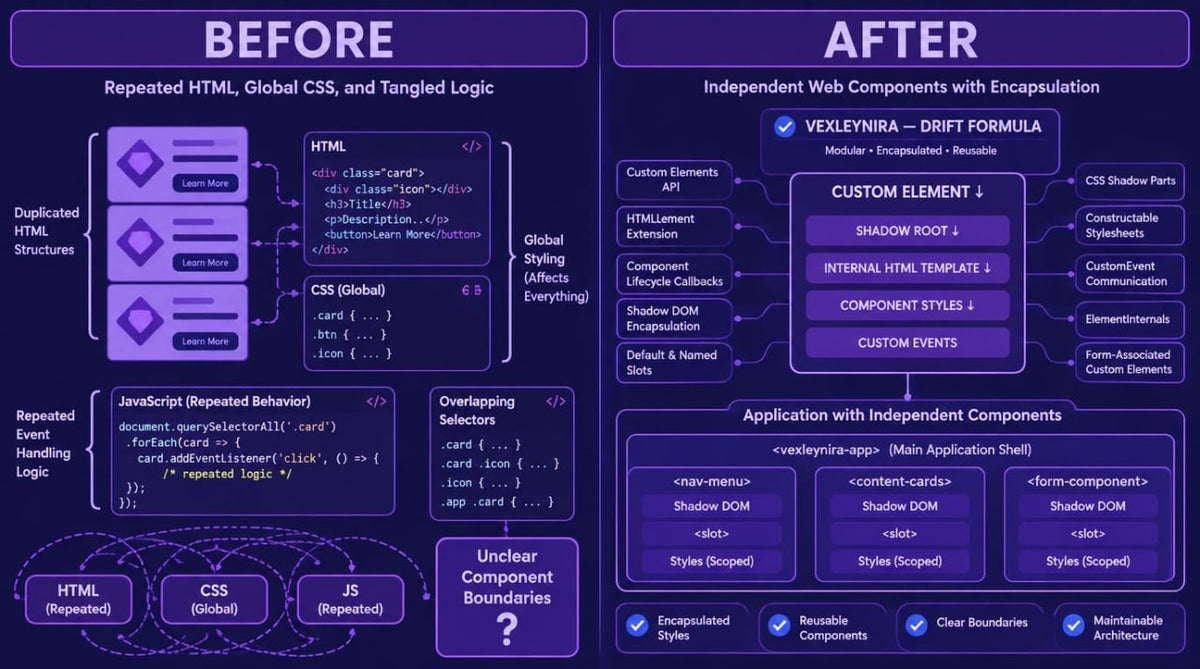
When developing large web interfaces, repeated components may contain complex styling, internal logic, and their own interaction rules, making them harder to reuse across different parts of a webpage. Standard CSS selectors do not always provide clear separation between a component's styling and the surrounding document styles. Recreating identical HTML structures and JavaScript logic increases code volume and complicates future maintenance. In addition, complex interface systems require coordinated management of component lifecycles, data communication, and event handling between independent elements.
2. Solution
Drift Formula introduces Web Components technology and the principles of creating custom HTML elements with defined structures and behavior. You will learn to use Custom Elements, Shadow DOM, and HTML Templates to build components with their own internal environments. Dedicated modules cover element lifecycles, communication through properties and attributes, event transmission, and component styling organization. In the final project, you will build a modular interface system with independent components, shared interaction rules, and reusable structural templates.
3. What's Inside
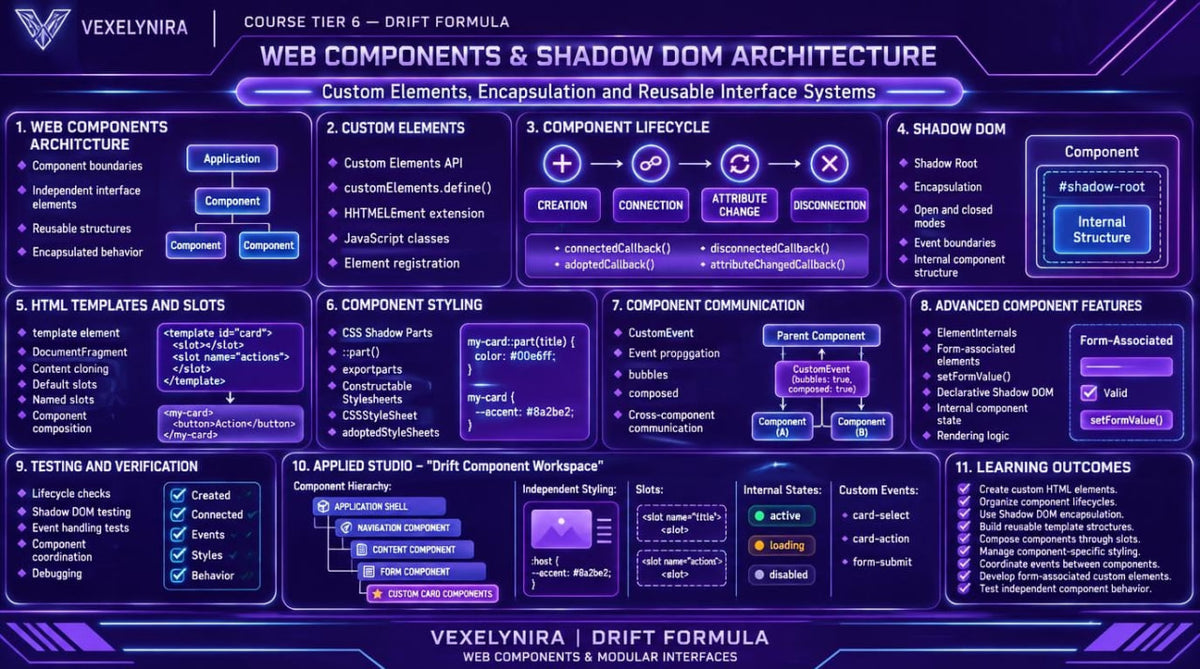
Module 1: Web Components Architecture
Explore the building blocks of Web Components and learn to define responsibility boundaries between individual interface components.
Module 2: Custom Elements and Registration
Learn to create custom HTML elements, register them through customElements.define(), and define their usage rules.
Module 3: HTMLElement Extension and Class Design
Study HTMLElement extension through JavaScript classes and learn to organize the internal logic of custom elements.
Module 4: Component Lifecycle Callbacks
Explore connectedCallback(), disconnectedCallback(), adoptedCallback(), and attributeChangedCallback() for managing component lifecycles.
Module 5: Observed Attributes and Reactive Properties
Learn to monitor HTML attribute changes, synchronize them with JavaScript properties, and update component rendering.
Module 6: Shadow DOM and Encapsulation
Explore Shadow Root creation, internal component structure isolation, and the interaction between Shadow DOM and the main document.
Module 7: Shadow DOM Modes and Event Boundaries
Study open and closed modes, event propagation boundaries, and interaction rules between internal and external elements.
Module 8: HTML Templates and Document Fragments
Learn to use template, slot, and DocumentFragment for building component structures without duplicating HTML markup.
Module 9: Slots and Component Composition
Explore default slots, named slots, and composition mechanisms that allow external content to be placed inside component structures.
Module 10: CSS Shadow Parts and Styling Contracts
Learn to use ::part(), exportparts, and the part attribute for controlled styling of internal component sections.
Module 11: Constructable Stylesheets
Explore CSSStyleSheet, replaceSync(), replace(), and adoptedStyleSheets for sharing stylesheets between components.
Module 12: Custom Events and Cross-Component Communication
Learn to create CustomEvent instances, configure bubbles and composed, and organize communication between independent components.
Module 13: ElementInternals and Custom Element States
Explore ElementInternals, internal custom element states, and mechanisms for connecting components with forms and browser interface features.
Module 14: Form-Associated Custom Elements
Learn to create custom form elements, work with formAssociated, setFormValue(), formResetCallback(), and input validation.
Module 15: Declarative Shadow DOM
Explore declarative Shadow DOM creation through HTML markup and examine its role in component structures prepared before JavaScript execution.
Module 16: Component State and Internal Rendering
Learn to organize internal component state, update component content, and separate rendering logic from data processing.
Module 17: Component Composition and Dependency Boundaries
Explore the construction of complex interfaces from smaller components, dependency communication rules, and interaction between structural layers.
Module 18: Testing and Debugging Web Components
Learn to examine custom element lifecycles, Shadow DOM behavior, event handling, and component coordination.
Module 19: Applied Studio — Drift Component Workspace
Create a modular interface featuring custom HTML elements, nested components, forms, slots, independent styles, and event communication between individual parts of the system.
4. Who Is This For?
A suitable choice if you:
✅ Already have HTML, CSS, and JavaScript knowledge at the level required to work with complex interfaces.
✅ Want to explore Web Components and custom HTML element creation.
✅ Are interested in styling and internal logic isolation.
✅ Want to study Shadow DOM, Slots, and Custom Elements.
✅ Want to create components with their own properties, attributes, and events.
✅ Work on large web interfaces with repeated structural elements.
✅ Are interested in native component architecture without third-party libraries.
This course may not suit you if you:
❌ Are not yet familiar with JavaScript classes, the DOM, and event handling.
❌ Have no experience creating structured HTML webpages.
❌ Are looking only for introductory HTML and CSS explanations.
❌ Expect detailed server-side development or server system architecture training.
5. What You'll Learn
After studying Drift Formula, you will be able to:
-
Explain Web Components architecture.
-
Create custom HTML elements through the Custom Elements API.
-
Register components and configure their behavior.
-
Extend HTMLElement through JavaScript classes.
-
Manage component lifecycles.
-
Monitor attribute changes and synchronize them with properties.
-
Create Shadow Roots and organize isolated element structures.
-
Understand event propagation boundaries within Shadow DOM.
-
Use HTML Templates for repeated structures.
-
Compose components through default and named slots.
-
Manage internal element styling through CSS Shadow Parts.
-
Use Constructable Stylesheets for shared styling.
-
Create custom events through CustomEvent.
-
Organize data communication between independent components.
-
Use ElementInternals with custom HTML elements.
-
Create components associated with HTML forms.
-
Work with Declarative Shadow DOM.
-
Organize internal component state and updates.
-
Build multi-layer component structures.
-
Examine component behavior and analyze errors.
-
Combine independent Web Components into one modular interface system.
6. Refund Information
Before placing an order, please review the official Vexleynira Refund Policy. The document outlines refund terms, request submission procedures, and the rules for reviewing related inquiries.
How are the learning materials organized?
How are the learning materials organized?
Each course is divided into themed modules containing technical explanations, code examples, and practical exercises. This structure helps learners examine individual concepts and understand how they relate to one another.
Do I need previous knowledge to study the courses?
Do I need previous knowledge to study the courses?
Not necessarily. The collection includes learning materials for beginners as well as courses covering extended HTML, CSS, and JavaScript topics. The recommended study level is stated in each course description.