Vexleynira
Elevate Stage
Elevate Stage
Couldn't load pickup availability
Share
- 📄 Digital file available after purchase
- ♾️ Long-term availability
- 🔐 Secure checkout
- 🗓️ Content updated in 2026
Self-paced learning overview
1. Problem Statement
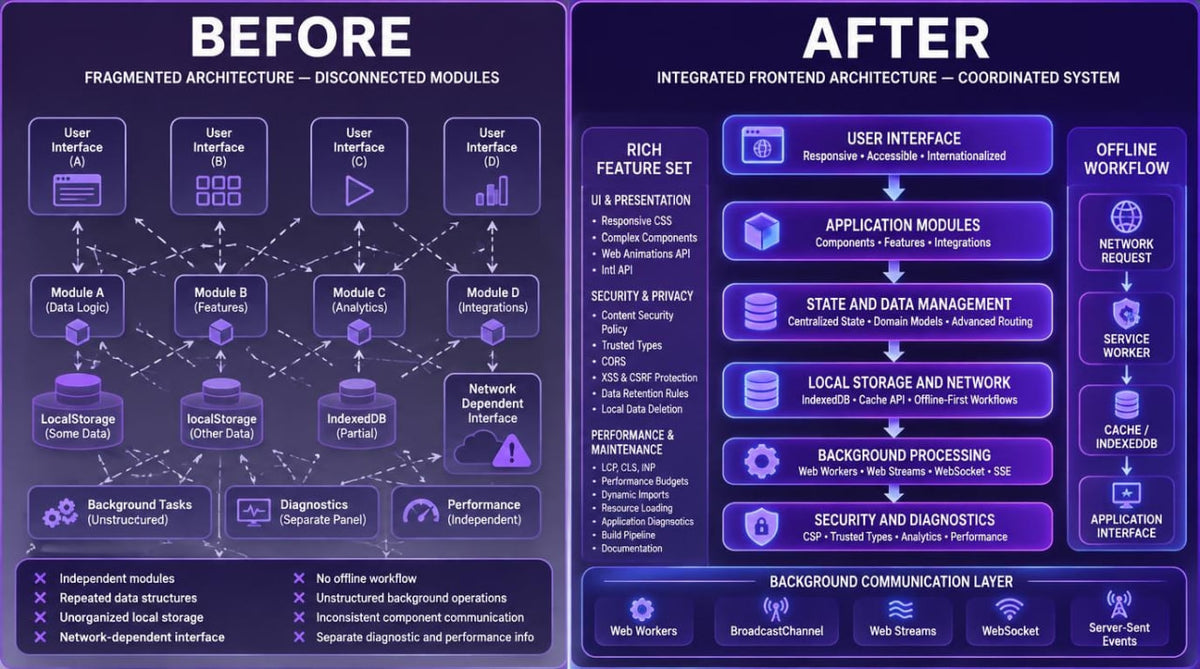
Building large web applications requires coordinated operation between multiple subsystems, including routing, state management, data storage, network communication, and interface rendering. When these subsystems are developed without a shared architectural model, difficulties arise with data communication, state restoration, error handling, and support for different operational scenarios. Additional challenges emerge during unstable network connections, parallel operations, local data updates, and browser resource management. Building a cohesive system requires consideration not only of individual component functionality but also of their interaction, security, performance, and long-term maintenance.
2. Solution
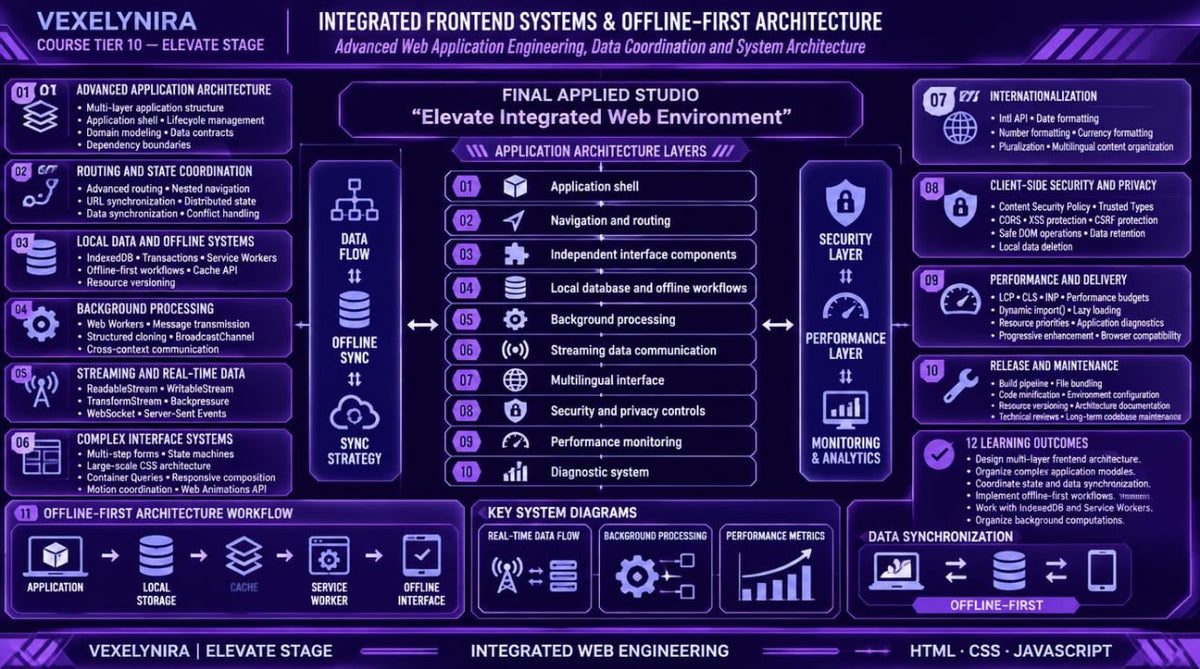
Elevate Stage combines advanced frontend development concepts into one comprehensive web application engineering program. You will learn to organize architectural layers, manage local data, create offline workflows, and coordinate background processes through browser APIs. Dedicated modules cover client-side security, streaming data processing, performance, internationalization, and web application release preparation. The final project involves creating an integrated web environment in which independent components, local storage, network operations, and interactive interfaces operate as one coordinated system.
3. What's Inside
Module 1: Enterprise Frontend Architecture
Explore multi-layer web application architecture, responsibility separation, module boundaries, and principles for organizing large client-side systems.
Module 2: Application Shell and Lifecycle Management
Learn to create an application shell, organize module initialization, manage page lifecycles, and release resources.
Module 3: Domain Modeling and Data Contracts
Study domain modeling, entity structures, data contracts, and communication rules between different architectural layers.
Module 4: Advanced Routing and Navigation Systems
Learn to create nested routes, dynamic URL parameters, navigation history management, and synchronization between navigation and application state.
Module 5: Distributed State and Data Synchronization
Explore centralized state management, component synchronization, coordination of local changes, and data conflict handling.
Module 6: IndexedDB and Transactional Storage
Learn to work with IndexedDB, create databases, indexes, transactions, and mechanisms for updating local data structures.
Module 7: Offline-First Architecture and Service Workers
Explore Service Workers, their lifecycle, network request interception, and workflows that operate without a permanent connection.
Module 8: Cache API and Resource Versioning
Learn to use the Cache API, create caching strategies, manage resource versions, and organize updates to locally stored resource copies.
Module 9: Background Processing with Web Workers
Study Web Workers, message transmission, structured cloning, and execution of computational tasks outside the main thread.
Module 10: Cross-Context Communication with BroadcastChannel
Learn to organize communication between browser tabs and separate browser contexts through BroadcastChannel.
Module 11: Web Streams and Incremental Data Processing
Explore ReadableStream, WritableStream, TransformStream, and principles of streaming large data volumes.
Module 12: Real-Time Communication and Event Streams
Learn to work with WebSocket and Server-Sent Events, process message streams, and synchronize data in interactive workflows.
Module 13: Complex Forms and Workflow State Machines
Study multi-step forms, state models, intermediate value preservation, input validation, and restoration of unfinished workflows.
Module 14: Large-Scale CSS Architecture
Learn to organize large stylesheets through CSS Layers, CSS Modules as a style isolation concept, nested rules, and reusable property systems.
Module 15: Advanced Responsive Composition
Explore complex responsive layouts, container queries, logical properties, fluid typography systems, and multi-section interface composition.
Module 16: Motion Systems and Rendering Coordination
Learn to coordinate CSS animations, Web Animations API, requestAnimationFrame(), and JavaScript states when creating complex animated interfaces.
Module 17: Internationalization and Localization Architecture
Study the Intl API, date, number, and currency localization, pluralization rules, text formatting, and multilingual content organization.
Module 18: Client-Side Security Architecture
Explore Content Security Policy, Trusted Types, CORS, protection against XSS and CSRF, safe DOM operations, and user data handling rules.
Module 19: Privacy-Aware Data Management
Learn to define local data retention periods, minimize personal information storage, and organize data deletion according to application lifecycles.
Module 20: Performance Budgets and Web Metrics
Explore LCP, CLS, and INP metrics, performance budgets, resource loading analysis, and operation execution time measurements.
Module 21: Resource Loading and Code Delivery Architecture
Learn to use dynamic import(), divide code into separate sections, organize lazy loading, and manage resource priorities.
Module 22: Observability and Application Diagnostics
Study structured logging, Performance API, PerformanceObserver, exception handling, and diagnostic information organization for client-side applications.
Module 23: Browser Compatibility and Progressive Enhancement
Learn to use feature detection, progressive interface enhancement, fallback workflows, and adaptation to different browser environments.
Module 24: Build Pipeline and Release Engineering
Explore web application release preparation, file bundling, code minification, environment configuration, and resource version management.
Module 25: Architecture Governance and Long-Term Maintenance
Learn to document architectural decisions, define dependency rules, organize technical reviews, and plan ongoing codebase maintenance.
Module 26: Applied Studio — Elevate Integrated Web Environment
Create a comprehensive web application featuring routing, independent components, a local database, offline mode, background computations, streaming data transmission, a multilingual interface, and a diagnostic system.
4. Who Is This For?
A suitable choice if you:
✅ Have substantial experience working with HTML, CSS, and JavaScript.
✅ Have already created complex web applications with interconnected components.
✅ Want to explore offline architecture and browser-based data storage mechanisms.
✅ Are interested in Service Workers, IndexedDB, and Web Workers.
✅ Want to organize background workflows and streaming data processing.
✅ Want to expand your knowledge of client-side security, data protection, and performance.
✅ Work with complex interfaces, APIs, and multi-module systems.
✅ Want to combine different areas of frontend development in one comprehensive project.
This course may not suit you if you:
❌ Are not yet familiar with HTML, CSS, and JavaScript fundamentals.
❌ Have no experience working with the DOM, APIs, and JavaScript modules.
❌ Are looking for introductory beginner-level materials.
❌ Expect detailed server-side programming, server administration, or database design training.
5. What You'll Learn
After studying Elevate Stage, you will be able to:
-
Design multi-layer architecture for large web applications.
-
Separate application logic into independent architectural modules.
-
Create domain models and data contracts.
-
Organize complex routing and navigation systems.
-
Manage state and synchronization between components.
-
Use IndexedDB for local structured data storage.
-
Create offline workflows using Service Workers.
-
Organize caching and resource versioning.
-
Perform background computations through Web Workers.
-
Organize communication between browser contexts.
-
Work with data streams and backpressure mechanisms.
-
Create interactive systems using WebSocket and Server-Sent Events.
-
Design complex forms and multi-step workflows.
-
Organize large-scale CSS architectures.
-
Create complex responsive interfaces.
-
Coordinate animations and graphical rendering.
-
Organize multilingual interfaces through the Intl API.
-
Apply Content Security Policy and Trusted Types.
-
Account for XSS, CSRF, and unsafe data handling risks.
-
Organize local information storage and deletion.
-
Analyze LCP, CLS, and INP.
-
Optimize resource loading and JavaScript code distribution.
-
Create diagnostic mechanisms for client-side applications.
-
Organize web application release preparation.
-
Document architectural decisions and maintain large codebase structures.
-
Combine HTML, CSS, and JavaScript into comprehensive web systems.
6. Refund Information
Before placing an order, please review the official Vexleynira Refund Policy. The document outlines refund terms, request submission procedures, and the rules for reviewing related inquiries.
How are the learning materials organized?
How are the learning materials organized?
Each course is divided into themed modules containing technical explanations, code examples, and practical exercises. This structure helps learners examine individual concepts and understand how they relate to one another.
Do I need previous knowledge to study the courses?
Do I need previous knowledge to study the courses?
Not necessarily. The collection includes learning materials for beginners as well as courses covering extended HTML, CSS, and JavaScript topics. The recommended study level is stated in each course description.